LOADING CONTENT

LOADING CONTENT
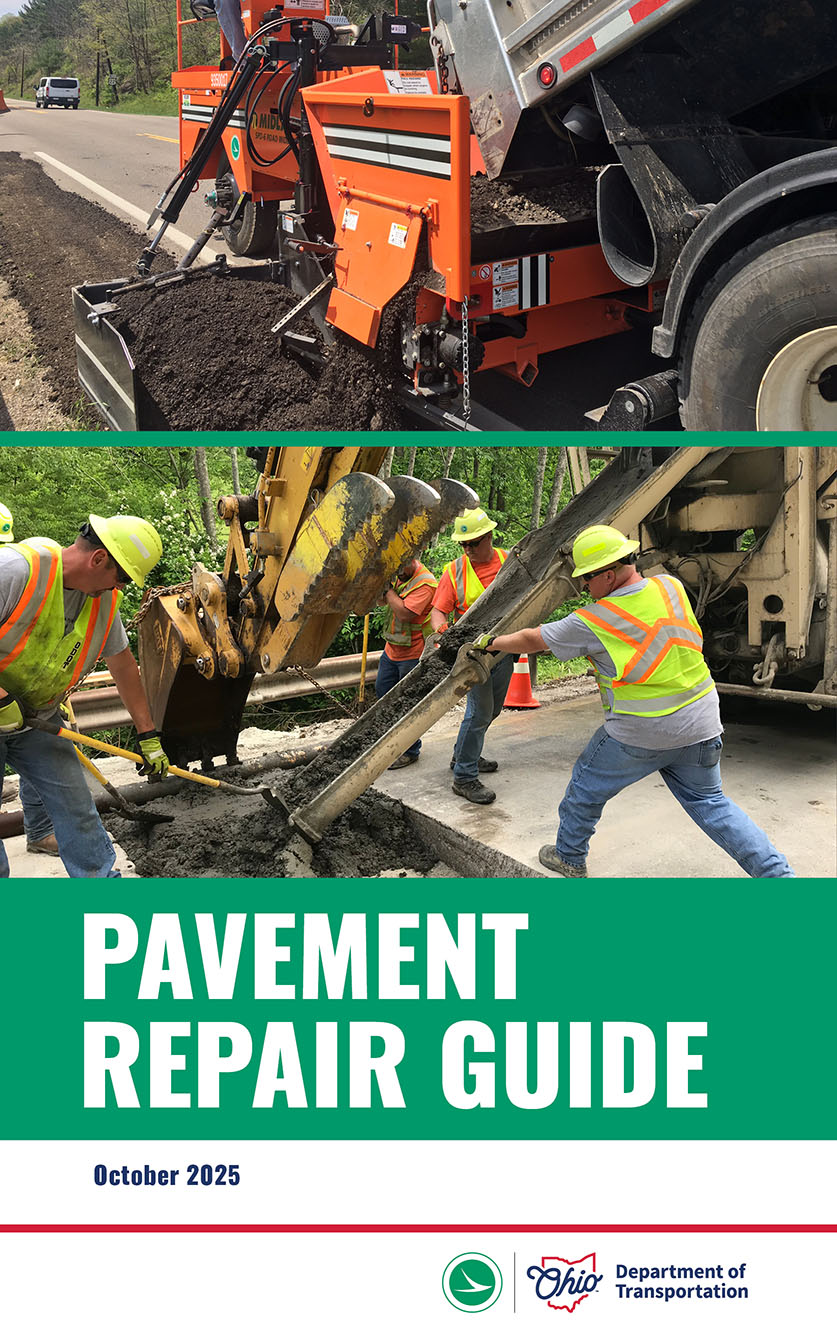
The purpose of this Guide is to present guidelines for the proper selection of pavement repairs. This Guide supplements the training course “Pavement Repair: Selection and Execution” with emphasis on identifying distresses, selecting appropriate repair strategies, and steps to properly perform repairs. The repairs covered include:
Item 251: Partial Depth Flexible Pavement Repair
Item 252: Full Depth Rigid Pavement Removal and Flexible Repair
Item 253: Full Depth Flexible Pavement Repair
Item 255: Full Depth Rigid Pavement Repair
Item 256: Partial Depth Rigid Pavement Repair
Item 258: Load Transfer Retrofit
Item 423: Crack Sealing, Item 254: Pavement Planing (and Patching Planed Surface), Item 257: Diamond Grinding Portland Cement Concrete Pavement, cross stitching, overlay, and reconstruction, are included in this Guide as appropriate, but not as repairs.
The item numbers listed and displayed in the flowcharts within this Guide refer to those in the Construction and Materials Specifications (C&MS). The titles for the item numbers are changed slightly in this Guide as compared to those in the C&MS for clarity.

The proper selection of a pavement repair strategy considers the type and age of the pavement structure as well as the type and severity of the distresses that need to be corrected. Selecting improper repairs or performing the repairs incorrectly can result in unnecessary costs and may lead to premature failures and the need to perform additional maintenance work.
The goal of this Guide and associated training course is to provide ODOT personnel who are involved with pavement repairs (such as designers, project engineers, construction inspectors, and maintenance forces) with information to select the proper pavement repair techniques for different situations.
The implementation of proper repair strategies is expected to reduce the possibility of premature failures leading to better performance and longevity of the highway network and lower maintenance and life cycle costs through improved efficiencies. The resulting improvement in pavement condition is also expected to lead to a higher level of drivability and comfort for drivers and passengers in Ohio.
Information in this Guide is presented within a framework designed to enable the reader in the planning stage to systematically select the appropriate repairs based on distress evaluation and project constraints.
The Guide presents the major distresses in asphalt, concrete, and composite pavements at various levels of severities. Each distress presented includes a description, likely causes, indicators of severity, potential repair options, and relevant notes. The distresses are categorized into repairable distresses and non-repairable distresses.
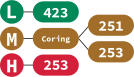
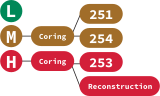
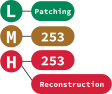
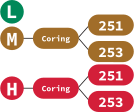
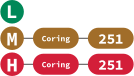
The repair selection for each distress is presented as text identifying the repair type that is most appropriate for the specified severity level. The repair selection is also presented as a flowchart, an example of which is shown below.
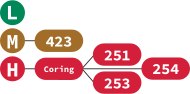
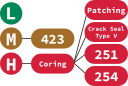
The flowchart is to be read from left to right with the first column of boxes representing the severity level of the distress (L = Low, M = Medium, H = High) and the subsequent boxes representing the appropriate repair options.
Below is the full list of potential repair and non-repair options.
251: Partial Depth Flexible Pavement Repair
252: Full Depth Rigid Pavement Removal and Flexible Repair
253: Full Depth Flexible Pavement Repair
254: Pavement Planing (and Patching Planed Surface)
255: Full Depth Rigid Pavement Repair
256: Partial Depth Rigid Pavement Repair
257: Diamond Grinding Portland Cement Concrete Pavement
258: Load Transfer Retrofit
423: Crack Sealing
Cross stitching
Overlay
Full Depth Reconstruction
Base: A structural pavement layer placed directly on the subbase or subgrade, designed to provide load distribution and support for surface layers.
Bleeding: The upward migration of asphalt binder to the pavement surface, creating a shiny, sticky film that can reduce skid resistance.
Debonding: Loss of adhesion between pavement layers (e.g., between asphalt lifts), often leading to slippage or cracking.
Faulting: Vertical displacement between adjacent concrete pavement slabs, typically at joints or cracks, caused by pumping or loss of support.
Planing or Milling: The controlled removal of pavement layers using a milling machine to restore surface profile, improve ride, or prepare for overlays.
Polishing: Smoothing of aggregate particles at the pavement surface under traffic, reducing skid resistance over time.
Pumping: Ejection of water and fine materials through pavement joints or cracks under traffic loads.
Raveling: Progressive disintegration of the pavement surface due to loss of aggregate particles, often from binder aging or poor compaction.
Rutting: Longitudinal surface depressions in the wheel paths caused by permanent deformation of pavement layers or subgrade.
Scaling: Localized flaking or peeling of the pavement surface, often caused by freeze-thaw cycles, poor finishing, or inadequate curing in concrete.
Shoving: A form of plastic movement in asphalt pavements where localized displacement creates ripples or bulges, often at intersections or braking areas.
Spalling: Breaking or chipping at the edges of joints or cracks in concrete pavement, often due to freeze-thaw action, load stresses, or poor joint construction.
Stripping: Separation of asphalt binder from aggregate surfaces due to moisture damage, leading to weakening and loss of mixture integrity.
Subbase: A pavement layer between the subgrade and base that provides additional structural support, drainage, and frost protection.
Subgrade: The prepared natural soil or embankment material on which the pavement structure is built, serving as the foundation for all pavement layers.
Maintain personal and traffic safety during inspections. Use proper high-visibility gear, cones, signs, and perform inspections during low-traffic periods or when lane closures are in place, if necessary.
Plan the distress identification survey in advance, considering the length and location of the pavement sections to be surveyed, traffic patterns, and safety concerns.
Review pavement historical data (e.g. overlay thicknesses, age, prior maintenance, progression of distresses) as part of the pavement evaluation.
Ensure that you have the proper tools such as crack width gauges, measuring tapes, paper forms, or digital devices (tablets or mobile apps) for recording data.
Perform inspections during dry conditions to ensure that distresses are visible and not obscured by standing water, snow, or mud. Wet conditions can hide distresses like cracking or potholes and can make measuring more difficult.
Make sure the pavement surface is free of debris, dirt, leaves, and any foreign materials that could obscure distresses. If necessary, sweep or wash the road before inspection to reveal cracks, spalling, or texture-related distresses such as bleeding or raveling.
Inspect under clear weather conditions to avoid visibility issues caused by fog, rain, or low light. Optimal visibility helps with identifying fine cracks and subtle surface texture problems.
Perform inspections in full daylight to maximize visibility. Direct sunlight permits clear observation of surface distresses, texture changes, and cracking. Avoid low-light conditions (early morning or late evening) when shadows might obscure the pavement surface.
Observe the entire pavement surface area of the roadway section. Looking at multiple distresses can help provide a holistic assessment of extent and severity of individual distresses.
Whenever possible, find as many facts about deficiencies in an area of pavement as can be found before making decisions about how to proceed with repairs. Quality field preparation will result in a better understanding of how best to proceed, and less stress on the actual day of repairs. Don’t rely entirely on opinions and suggestions. Even advice from the most experienced sources is enhanced greatly by fact-based field research and planning.
Record data or inspection notes immediately during the inspection to avoid memory-related errors. Use digital tools or paper logs to document findings in real-time.
Review the drainage system and check for evidence of poor water management, such as surface water pooling, inadequate drainage design, blocked or partially blocked underdrain outlets, or subsurface water infiltration.
Use core sampling or non-destructive testing techniques to confirm whether deeper issues are contributing to visible distresses. Surface distress (e.g., surface cracking, spalling) might mask underlying structural problems in the subbase or subgrade.
Coring data from the same section from a previous investigation may be used to help make the decision regarding the repair depth and type.
Description: Longitudinal or crescent shaped cracks located between the edge of the pavement and the wheel path.
Most Likely Cause: Inadequate pavement structure due to improper widening, poor drainage, frost heave under the edge of the pavement, and/or vehicles running close to the edge of the pavement.
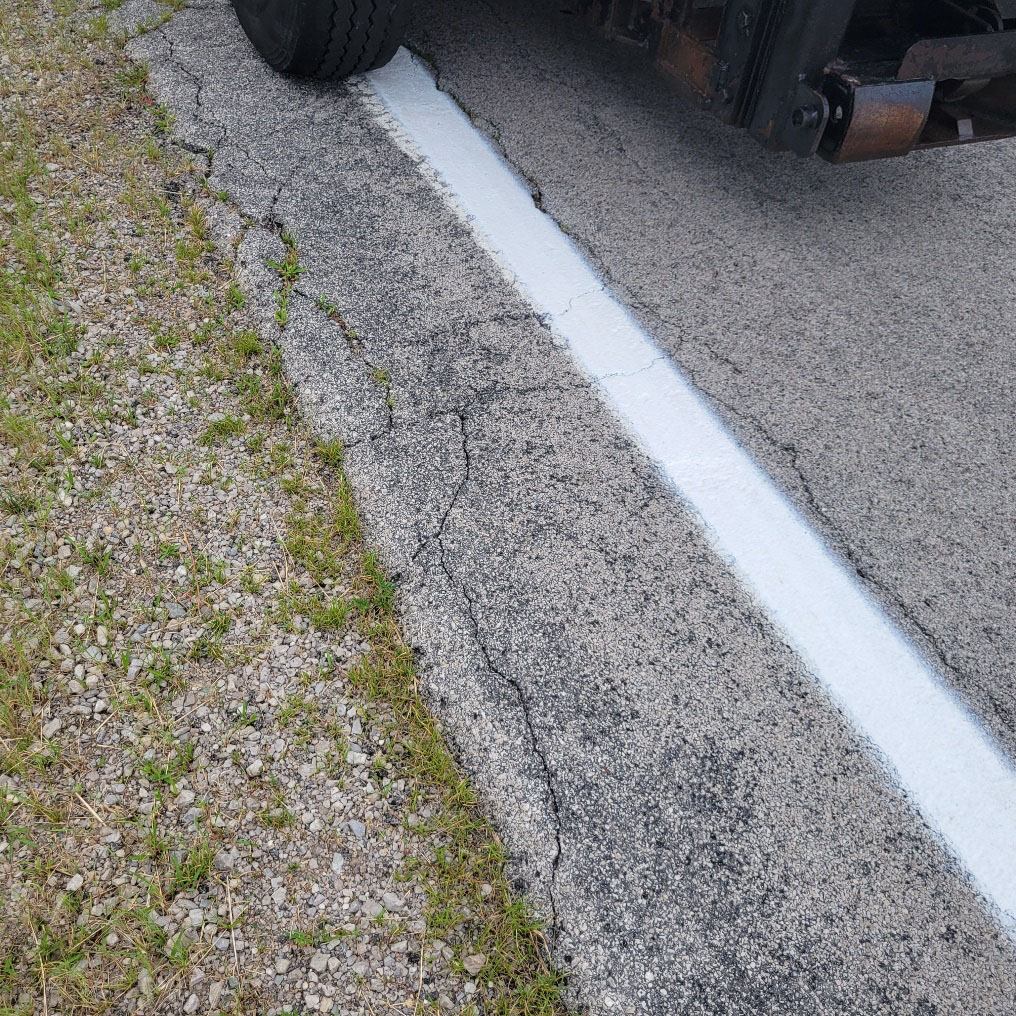
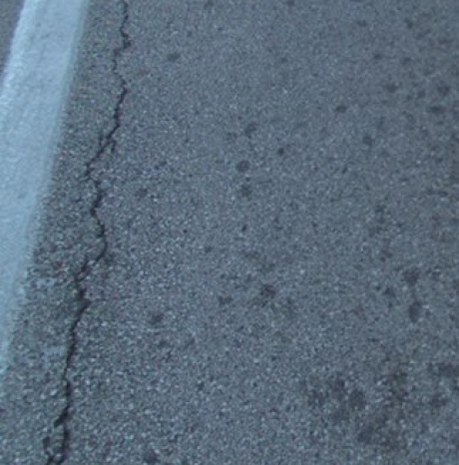
Low Severity
Tight cracks with an average crack width larger than 1/4 inch and with no breakups.
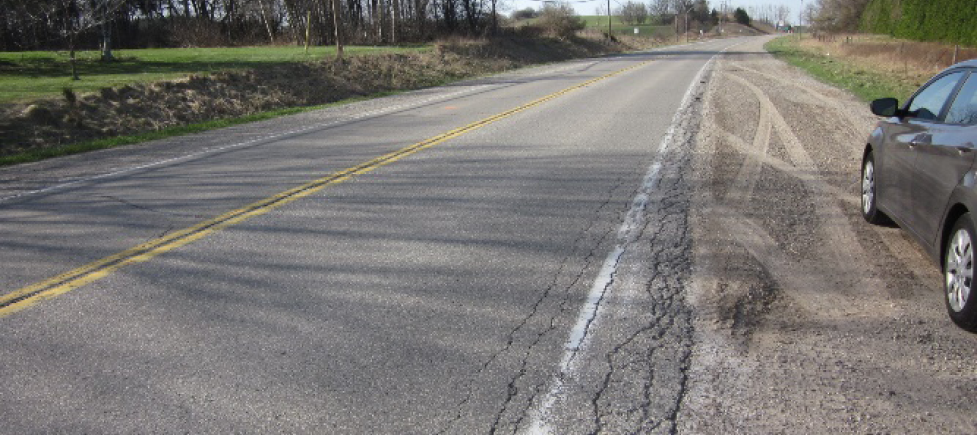
Medium Severity
Single or multiple cracks with some breakups.
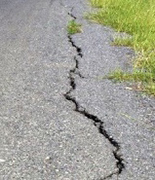
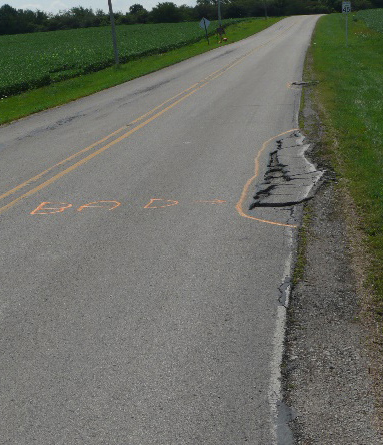
High Severity
Single or multiple wide cracks causing edge failures and potential safety concerns.
Low Severity: Crack Sealing (Item 423).
Medium Severity: Partial Depth Flexible Pavement Repair (Item 251) or Full Depth Flexible Pavement Repair (Item 253) (see notes).
High Severity: Full Depth Flexible Pavement Repair (Item 253).
Notes:
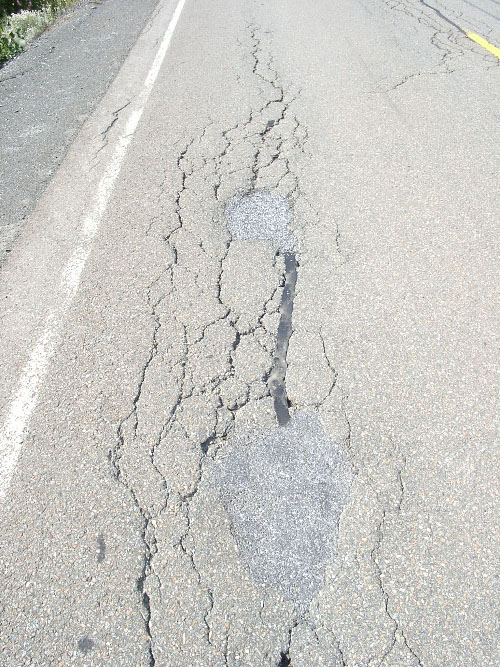
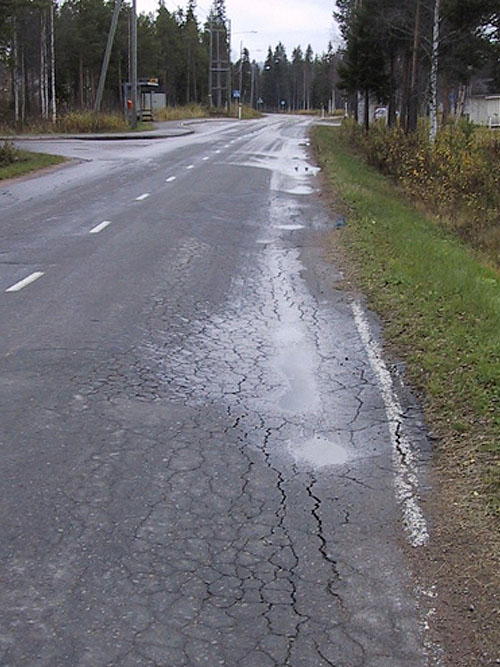
Description: Cracks located in or near the wheel track.
Most Likely Cause: Repeated traffic loading.
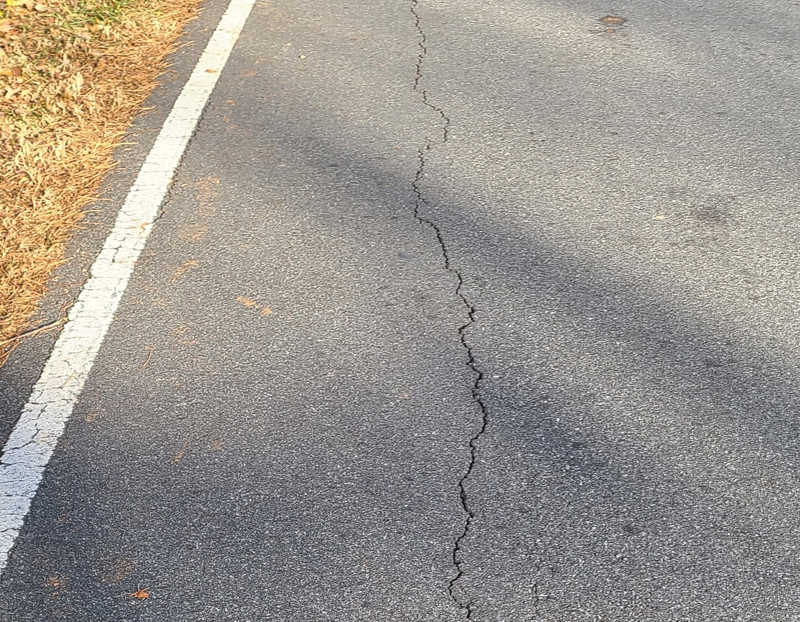
Low Severity
Single or intermittent cracks with an average crack width less than 1/8 inch.
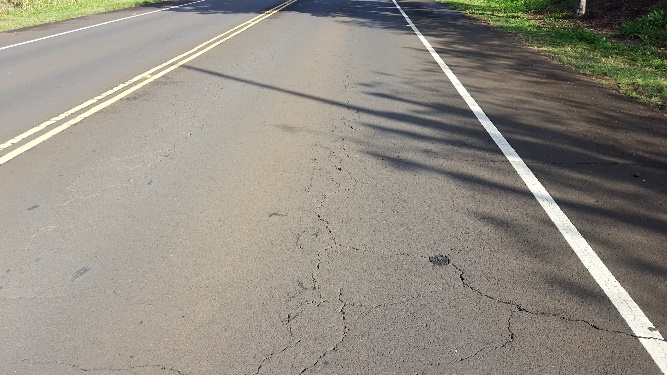
Medium Severity
Single or multiple interconnected cracks with an average crack width between 1/8 inch and 1/4 inch with some spalling or loose pieces.
High Severity
Extensive interlocking “alligator” cracks with an average crack width larger than 1/4 inch and/or some loose alligator blocks.
Low Severity: Do nothing.
Medium Severity: Crack Sealing (Item 423).
High Severity: Partial Depth Flexible Pavement Repair (Item 251), Full Depth Flexible Pavement Repair (Item 253), or Pavement Planing (Item 254) and overlay (see notes).
Notes:
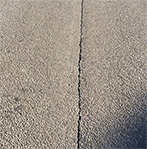
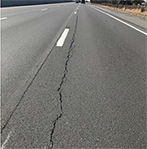
Description: Longitudinal cracks that are formed along the asphalt joint.
Most Likely Cause: Inadequate compaction along the asphalt joint during construction. Phase joint reflection on full depth reconstruction projects.
Low Severity
Continuous or intermittent cracks with an average crack width less than 1/4 inch.
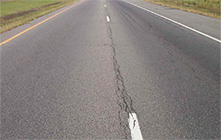
Medium Severity
Continuous or intermittent cracks with an average crack width between 1/4 inch and 1 1/2 inches with some spalling or loose pieces.
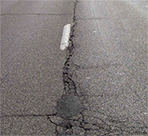
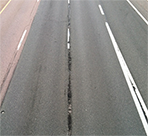
High Severity
Continuous cracks with an average crack width greater than 1 1/2 inches and/or significant spalling, loose pieces, or missing material.
Low Severity: Do nothing.
Medium Severity: Crack Sealing (Item 423).
High Severity: Patching, Type V Crack Seal (mastic), Partial Depth Flexible Pavement Repair (Item 251), or Pavement Planing (Item 254) as part of a future pavement resurfacing project (see notes).
Notes:
Description: Vertical depressions in the pavement surface along the wheel tracks.
Most Likely Cause: Permanent deformation or lateral movement of one or more of the pavement layers (including subgrade) under traffic.
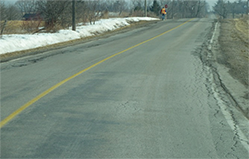
Low Severity
Barely noticeable, depth less than 3/8 inch.
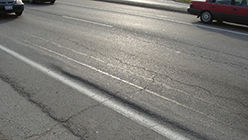
Medium Severity
Readily noticeable with a depth more than 3/8 inch and less than 3/4 inch.
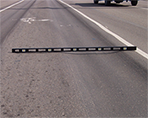
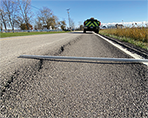
High Severity
Readily noticeable with a depth greater than 3/4 inch.
Low Severity: Do nothing.
Medium Severity: Need to identify the root cause(s) of rutting to develop a corrective strategy (see notes). Typically Pavement Planing (Item 254) and overlay.
High Severity: Need to identify the root cause(s) of rutting to develop a corrective strategy (see notes). Typically Pavement Planing (Item 254) and overlay.

Notes:
Description: A dip in the longitudinal profile of the pavement surface. Settlement may or may not be accompanied by other distresses.
Most Likely Cause: Weak subgrade, inadequate compaction of subgrade or base course, poor drainage, subsurface erosion or soil movement, excessive traffic loads, or poor construction techniques.
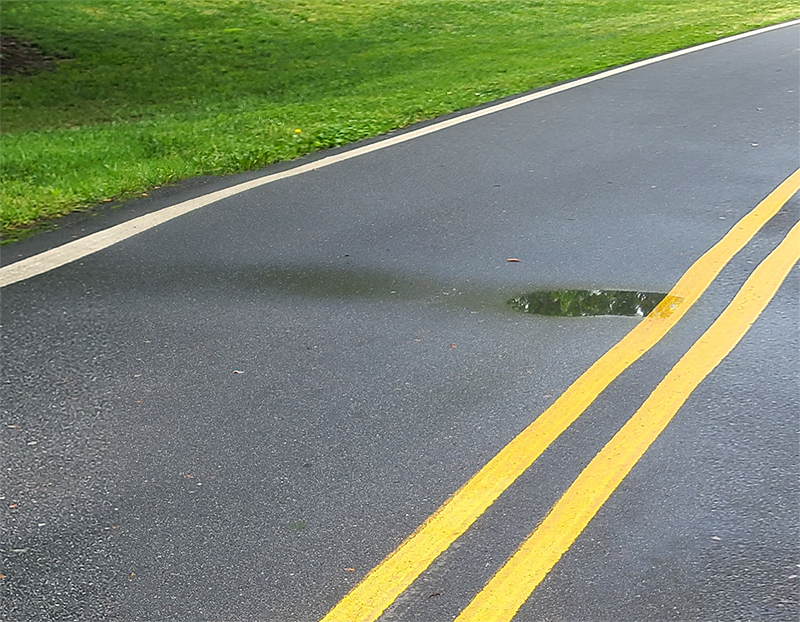
Low Severity
Drivers able to maintain ride easily.
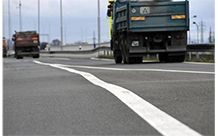
Medium Severity
Drivers able to maintain ride with slight corrective action.
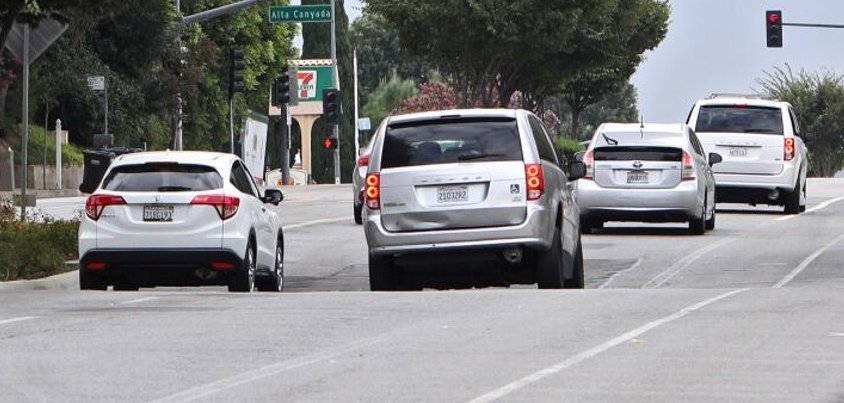
High Severity
Noticeable dip in pavement surface generally greater than 4 inches. High potential for poor ride quality.
Low Severity: Do nothing.
Medium Severity: Partial Depth Flexible Pavement Repair (Item 251) or Pavement Planing (Item 254) and overlay (see notes).
High Severity: Full Depth Flexible Pavement Repair (Item 253) or pavement reconstruction (see notes).
Notes:
Description: Loss or separation of the asphalt layer from the underlying layer.
Most Likely Cause: Poor tack coat bonding between the layers during construction, freeze-thaw action, or isolated areas of poor density.
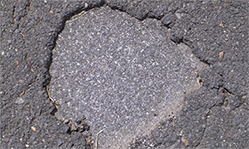
Low Severity
Debonding in the asphalt surface layer in a relatively small area (less than 4 square feet).
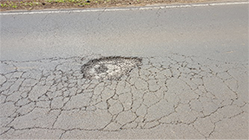
Medium Severity
Debonding in one or more asphalt layers in a relatively small to medium area (4 to 9 square feet).
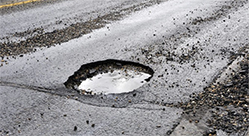
High Severity
Debonding in one or more asphalt layers in a relatively large area (greater than 9 square feet).
High Severity: Partial Depth Flexible Pavement Repair (Item 251) or Pavement Planing (Item 254) and overlay (see notes).

Notes:
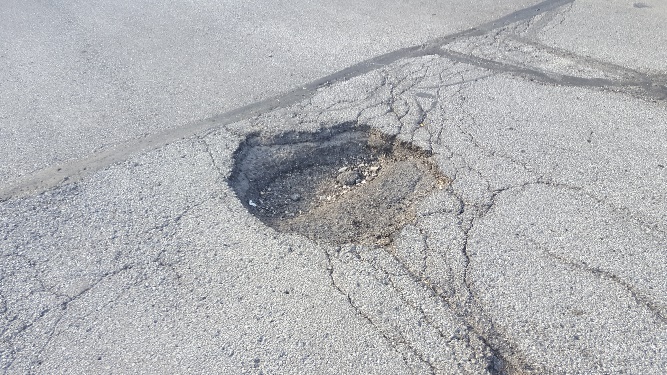
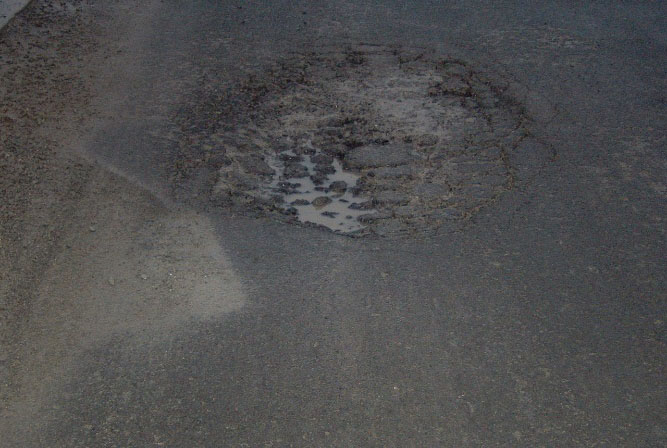
Description: Localized bowl-shaped holes in the pavement surface that extend deep into the pavement.
Most Likely Cause: Localized failure areas which are usually caused by weak asphalt, base or subgrade layers. Poor drainage and repeated freeze–thaw cycles are also contributing factors.
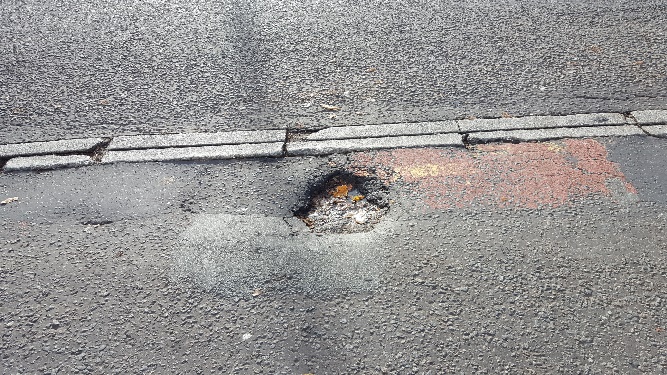
Low Severity
Potholes with a depth greater than 2 inches over an area smaller than 4 square feet.
Medium Severity
Potholes with a depth greater than 2 inches over an area greater than 4 square feet and less than 9 square feet.
High Severity
Potholes with a depth greater than 2 inches over an area greater than 9 square feet.
Notes:
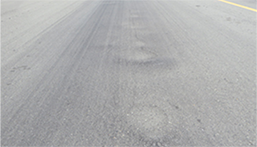
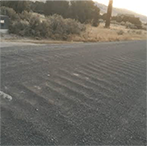
Description: A wave-like bulge or ripple in the asphalt surface, often appearing at locations where vehicles frequently slow down or stop.
Most Likely Cause: Weak or unstable asphalt mix along with forces from braking and turning of heavy vehicles.
Low Severity
Barely noticeable. Maximum depth less than 3/8 inch.
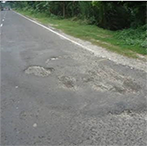
Medium Severity
Readily noticeable with a maximum depth more than 3/8 inch and less than 3/4 inch.
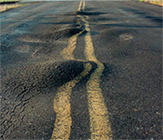
High Severity
Readily noticeable with a maximum depth greater than 3/4 inch.
Low Severity: Do nothing.
Medium or High Severity: Partial Depth Flexible Pavement Repair (Item 251) or Full Depth Flexible Pavement Repair (Item 253).
Notes:
Description: Crescent-shaped crack where the top asphalt layer has slipped over the underlying layer.
Most Likely Cause: Poor bonding between asphalt layers due to missing or insufficient tack coat or a low-strength surface asphalt mix, along with forces from braking and turning of heavy vehicles.
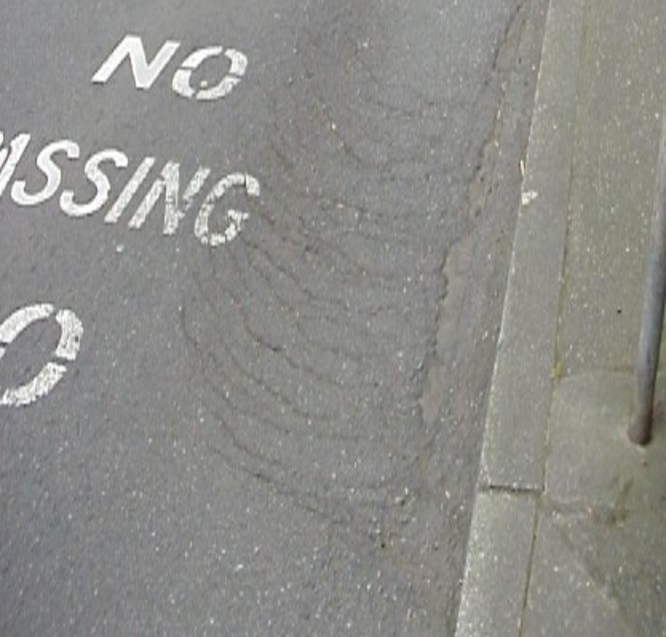
Low Severity
Closely spaced hairline cracks with no breakups.
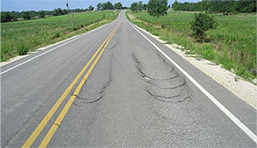
Medium Severity
Cracks clearly noticeable with minimal breakups.
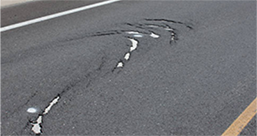
High Severity
Cracks clearly noticeable with breakups and clear separation from the underlying layer.
Low Severity: Do nothing.
Medium or High Severity: Partial Depth Flexible Pavement Repair (Item 251).

Notes:
Description: Disintegration of pavement surface.
Most Likely Cause: Aggregate loss, asphalt binder aging, poor mixture quality, segregation, or insufficient compaction.
Design Do nothing, Pavement Planing (Item 254) and overlay, surface treatment or Partial Depth Flexible Pavement Repair (Item 251) only if isolated.
Construction: Do nothing, Pavement Planing (Item 254) and overlay, surface treatment, or Partial Depth Flexible Pavement Repair (Item 251) only if isolated.
Maintenance: Do nothing or Partial Depth Flexible Pavement Repair (Item 251) only if isolated.
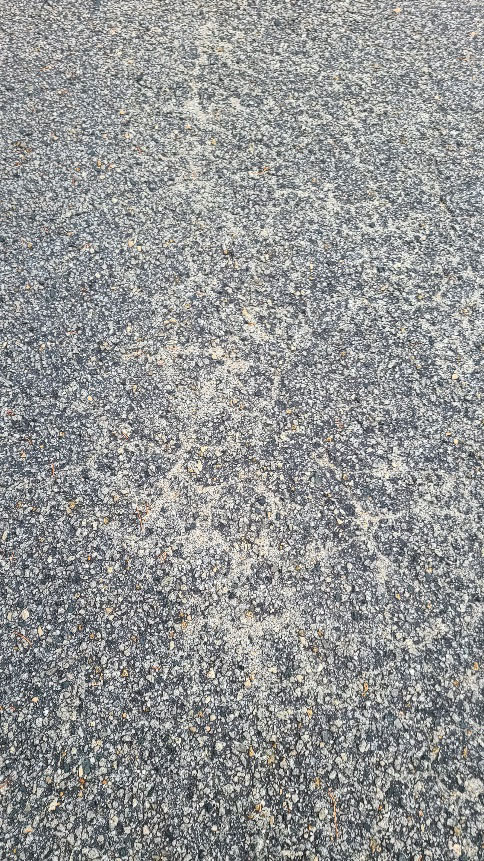
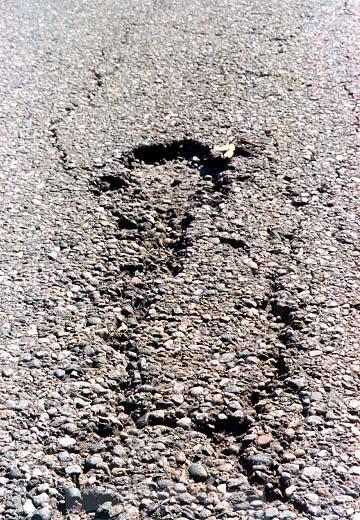
Description: Presence of free asphalt binder on the pavement surface.
Most Likely Cause: Excess amount of binder in the mixture and/or low air void content. More common on hot days, which reduces the viscosity of the asphalt binder.
Design Do nothing, surface treatment, or Pavement Planing (Item 254) and overlay.
Construction: Do nothing, surface treatment, or Pavement Planing (Item 254) and overlay.
Maintenance: Sand bleed spots to soak up excess binder.
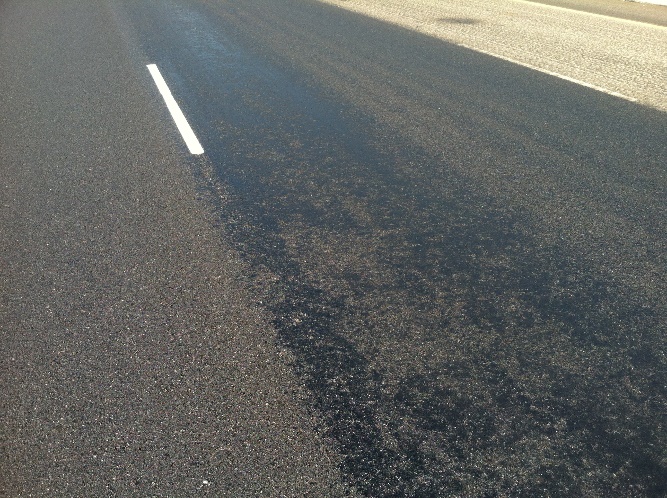
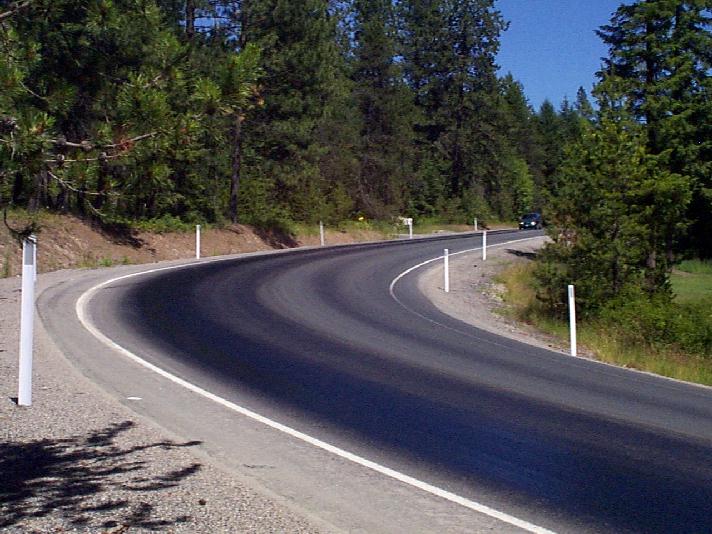
Description: A series of evenly spaced cracks that are perpendicular to the centerline of the road and extend from one side of the road to the other.
Most Likely Cause: As asphalt pavements are exposed to cold temperatures during the winter months, thermal stresses develop due to the shrinkage of the asphalt layers. When the asphalt surface layer can no longer support the tensile stresses resulting from the temperature drop, thermal cracking occurs. Asphalt aging is also a contributing factor to this type of distress.
Design Do nothing, Crack Sealing (Item 423), or Pavement Planing (Item 254) and overlay.
Construction: Do nothing, Crack Sealing (Item 423), or Pavement Planing (Item 254) and overlay.
Maintenance: Crack Sealing (Item 423) or spot planing.
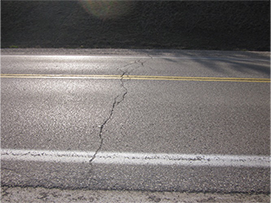
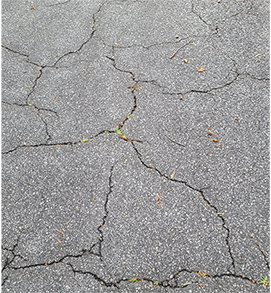
Description: Interconnected cracks which divide the pavement into rectangular pieces or blocks.
Most Likely Cause: Thermal shrinkage and binder age hardening.
Design Do nothing, Crack Sealing (Item 423), or Pavement Planing (Item 254) and overlay.
Construction: Do nothing, Crack Sealing (Item 423), or Pavement Planing (Item 254) and overlay.
Maintenance: Do nothing or Crack Sealing (Item 423).
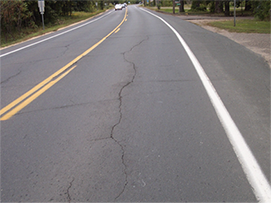
Description: Longitudinal cracks that are formed in the middle of the lane.
Most Likely Cause: Auger gearbox segregation during asphalt paving. Inadequate compaction along the asphalt joint during construction. Phase joint reflection on full depth reconstruction projects.
Design Do nothing, Pavement Planing (Item 254) and overlay, or Crack Sealing (Item 423).
Construction: Do nothing, Pavement Planing (Item 254) and overlay, or Crack Sealing (Item 423).
Maintenance: Do nothing or Crack Sealing (Item 423).
Description: Cracking, breaking, or chipping of the concrete surface along the longitudinal joint.
Most Likely Cause: Improper joint sawing (delayed or shallow cuts), inadequate load transfer due to missing or insufficient tie bars, and moisture infiltration leading to freeze-thaw damage.
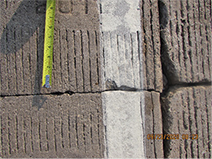
Low Severity
Small damaged area that extends less than 2 inches from the joint. Typically, less than 2 inches deep and less than 12 inches long.
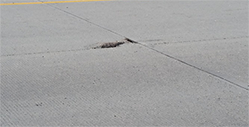
Medium Severity
One or two areas per slab or joint larger than low severity.
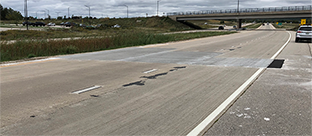
High Severity
Three or more areas per slab or joint larger than low severity.

Notes:
Description: Cracking, breaking, or chipping of the concrete surface along the transverse joint.
Most Likely Cause: Improper joint sawing (delayed or shallow cuts), inadequate load transfer due to misaligned or missing dowel bars, and moisture infiltration leading to freeze-thaw damage.
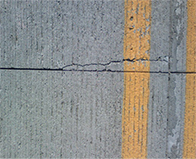
Low Severity
Small damaged area extends less than 2 inches from the joint. Typically, less than 2 inches deep and less than 12 inches long.
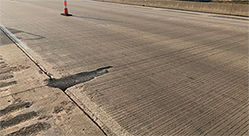
Medium Severity
One or two areas per slab or joint larger than low severity.
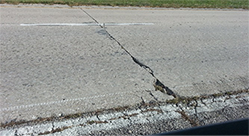
High Severity
Three or more areas per slab or joint larger than low severity.
Low Severity: Do nothing.
Medium Severity Partial Depth Rigid Pavement Repair (Item 256), Crack Seal Type V, or Spray Patching.
High Severity: Full Depth Rigid Pavement Repair (Item 255).

Notes:
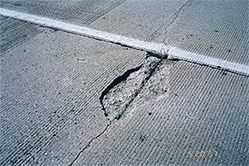
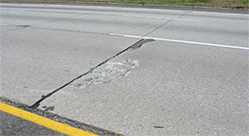
Description: Spalling and crushing due to upheaval at transverse joints or cracks.
Most Likely Cause: Expansion of the concrete layer.
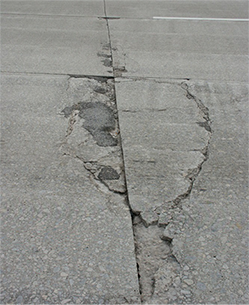
High Severity
Large spalls with broken pieces of concrete.
All pressure damage spalling is considered high severity since this distress may be a predictor of more serious pressure distress such as blowup, also known as buckling.

Notes:
Description:A crack or break approximately parallel to the pavement centerline.
Most Likely Cause: Subgrade settlement, repetitive high load stresses, insufficient support, or delay in sawing of the longitudinal joint during construction.
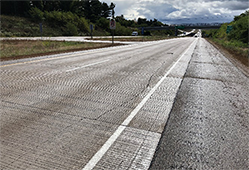
Low Severity
Hairline or tight cracks with little crack spalling.
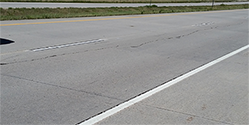
Medium Severity
Crack opened or spalled at the surface to a width of about 1/4 inch to 1 inch over a distance equal to at least one-half the crack length.
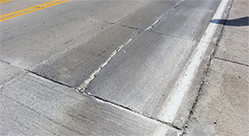
High Severity
Faulted crack or crack opened or spalled at the surface to a width greater than 1 inch over a distance equal to at least one-half the crack length.
Low Severity: Do nothing.
Medium Severity Cross Stitching.
High Severity: Full Depth Rigid Pavement Repair (Item 255).

Notes:
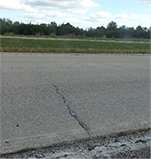
Description: A crack or break at approximately right angles to the pavement centerline.
Most Likely Cause: Repeated heavy traffic loading, thermal and moisture gradients and subgrade settlement or consolidation. Poor construction practices or concrete mixture quality.
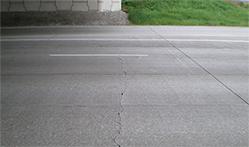
Low Severity
Hairline or tight cracks with little crack spalling.
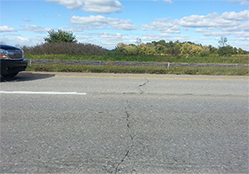
Medium Severity
Crack width is larger than hairline, but less than 1/4 inch.
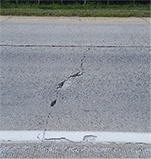
High Severity
Crack width is larger than 1/4 inch or spalled.
Low Severity: Do nothing.
Medium Severity: Full Depth Rigid Pavement Repair (Item 255) or Load Transfer Retrofit (Item 258).
High Severity: Full Depth Rigid Pavement Repair (Item 255).

Notes:
Description: Crack that intersects transverse joint or crack and a longitudinal edge diagonally.
Most Likely Cause: Loss of subgrade or base support, often due to water infiltration, subgrade erosion, or differential settlement. Corner breaks are sometimes longitudinal cracks that start at a transverse joint and turn towards the longitudinal joint rather than progress the full length of the slab.
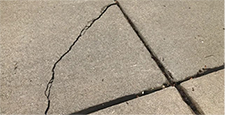
Low Severity
Hairline or tight cracks with little crack spalling.
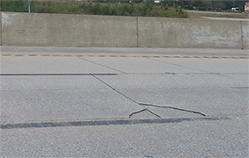
Medium Severity
Crack opened to a width of about 1/4 inch to 1 inch with some spalling and minor settlement of the broken area.
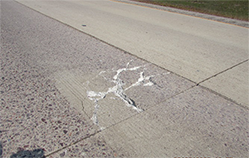
High Severity
Crack width greater than 1 inch and/or much spalling and settlement of the broken area or shattering of the broken area by formation of smaller pieces within the corner break area

Notes:
Description: Ejection of water and fine soil particles through pavement cracks, joints, or along pavement edges.
Most Likely Cause: Water entering through joints or cracks, combined with repeated heavy vehicle loads, poor load transfer at joints, poor drainage/blocked underdrains and weak subgrade or base layers.
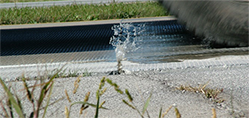
Pumping action due to wheel load. Depending on the amount of water and traffic loading, pumping action may not be observed during evaluation. The signs of pumping are staining from the water and fines on the shoulder.
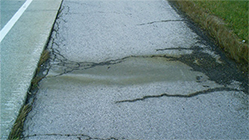
Low Severity
Small amount of surface staining from water and subgrade material at the lane-shoulder joint.
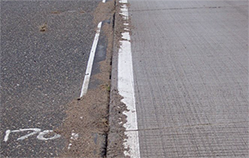
High Severity
Significant amount of subgrade material and surface staining at the lane-shoulder joint.
Low Severity: Do nothing.
Medium or High Severity: Appropriately-sized Full Depth Rigid Pavement Repair (Item 255).

Notes:
Description: Difference in elevation between abutting slabs at transverse joints or cracks.
Most Likely Cause: Movement of underlying fine-grained materials from one side to the other of joint or crack, settlement of soft subgrade, or curling or warping of slabs due to temperature and moisture.
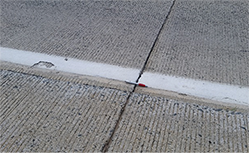
Low Severity
Less than 0.2 inch.
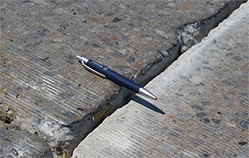
Medium Severity
0.2 to 0.4 inch.
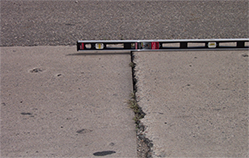
High Severity
Greater than 0.4 inch.
Low Severity: Do nothing.
Medium Severity: Load Transfer Retrofit (Item 258).
High Severity: Full Depth Rigid Pavement Repair (Item 255).

Notes:
Description:Dip or depression in the longitudinal profile of the pavement surface.
Most Likely Cause:Subgrade or base instability, inadequate compaction of base or subgrade, water infiltration, poor drainage, heavy traffic loads, water-induced erosion, and moisture changes in expansive soils.
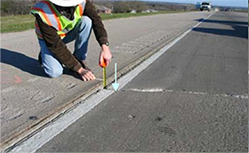
Low Severity
Drivers able to maintain ride easily.
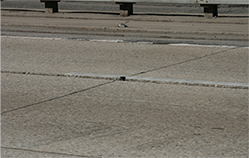
Medium Severity
Drivers able to maintain ride with slight corrective action
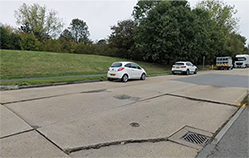
High Severity
Noticeable dip in pavement surface generally greater than 4 inches. High potential for poor ride quality and slab cracking.
Low Severity: Do nothing.
Medium or High Severity: Appropriately-sized Full Depth Rigid Pavement Repair (Item 255).

Notes:
Description: Disintegration or loss of material from the surface. Includes scaling (peeling or flaking of surface) and popout (small cavity due to localized surface aggregate loss). Typical depth is less than 1⁄2 inch. Concrete is sound below the distressed surface
Most Likely Cause: Weathering, traffic wear, high steel, or concrete mixture/construction issues.
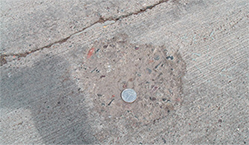
Surface concrete loss due to concrete mixture or construction issues.
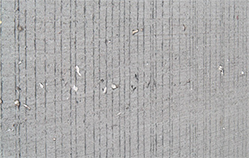
Wood chips in concrete surface.
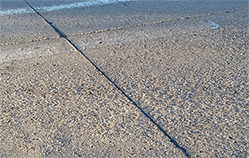
Weathering of surface.
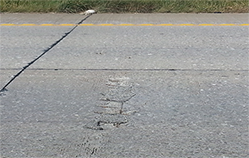
Surface deterioration due to high steel.
Do nothing in most cases. Diamond Grinding Portland Cement Concrete Pavement (Item 257) for low to medium severity deterioration. Full Depth Rigid Pavement Repair (Item 255) or overlay for high severity or extensive deterioration. Item 257 should not be used for pavement sections with high steel. High steel areas may be a candidate for Partial Depth Rigid Pavement Repair (Item 256)
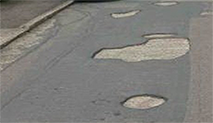
Description: Loss or separation of the asphalt layer from the underlying layer.
Most Likely Cause: Poor tack coat bonding between the layers during construction, freeze-thaw action, or isolated areas of poor density.
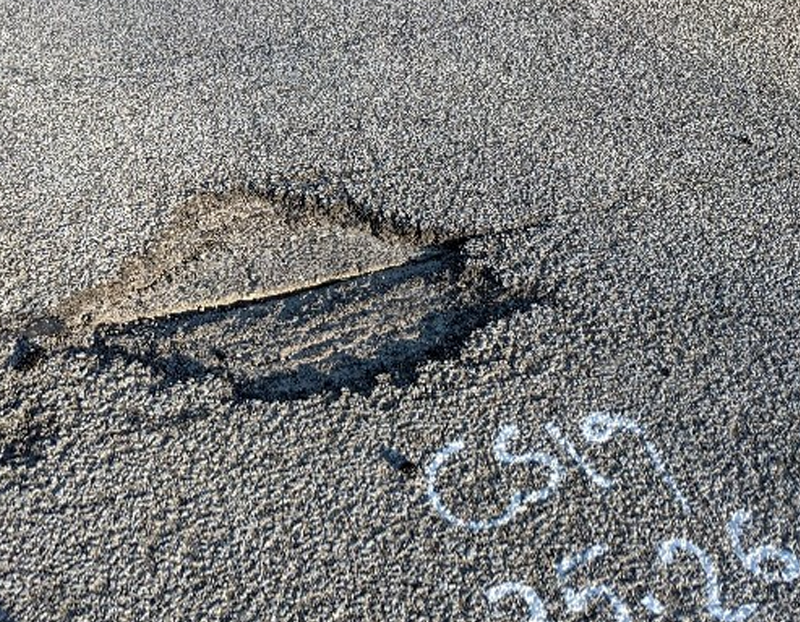
Low Severity
Debonding in the asphalt surface layer in a relatively small area (less than 4 square feet).
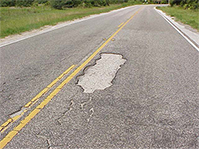
Medium Severity
Debonding in the asphalt surface layer in a relatively small area (less than 4 square feet).
High Severity
Debonding in one or more asphalt layers in a relatively large area (greater than 9 square feet).

Notes:
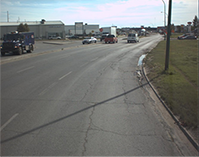
Description:Breakup of the underlying rigid concrete base as evidenced by surface reflection cracking and/or distortion. Reflection cracks forming rectangular areas smaller than 5 feet by 5 feet may indicate a broken underlying slab.
Most Likely Cause: Poor base support or fatigue failure of the underneath concrete layer.
Low Severity
Cracks defining the shattered area are tight (less than 1⁄8 inch wide) with little or no spalling. There is no faulting of the shattered area.
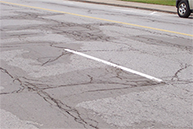
Medium Severity
Crack width greater than 1⁄8 inch with some spalling. Moderate distortion which does affect ride quality.
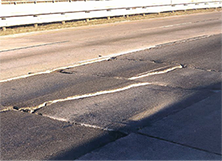
High Severity
Severe distortion and poor ride quality over the shattered area.
Low Severity: Do nothing.
Medium or High Severity: Full Depth Rigid Pavement Repair (Item 255).

Notes:
Description: A crack or break at approximately perpendicular to the centerline of the road.
Most Likely Cause: Cracks and joints that eventually reflect from the underlying concrete base. In some cases, the result of thermal shrinkage and age hardening of the surface asphalt layer.
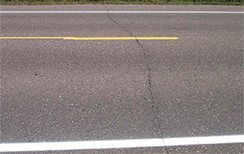
Low Severity
Average crack width less than 1⁄4 inch with no spalling.
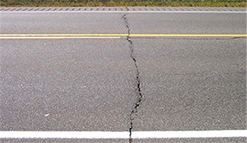
Medium Severity
Average crack opened or spalled to a width between 1⁄4 inch and 1 1⁄2 inches along at least half of its length.
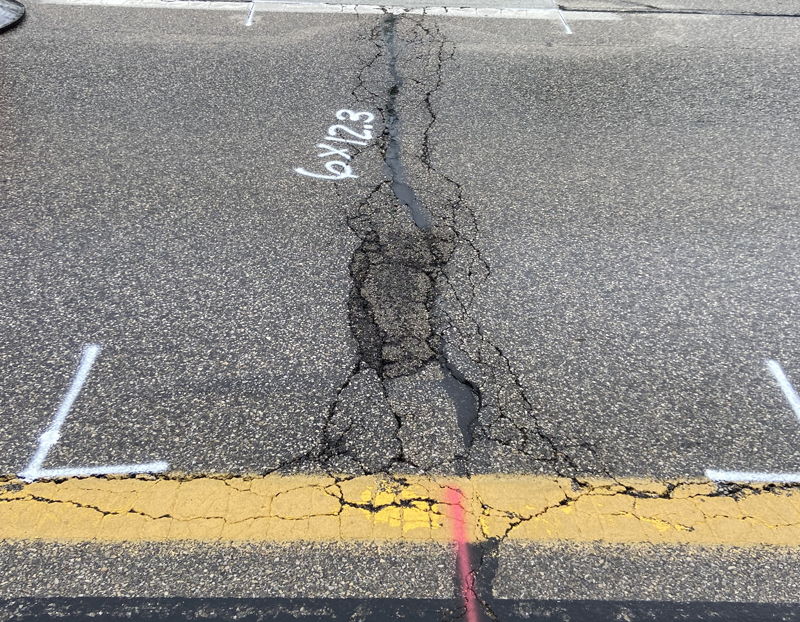
High Severity
Average crack opened or spalled to a width greater than 1 1⁄2 inches along at least half of its length.
Low Severity: Do nothing.
Medium Severity Crack Sealing (Item 423).
High Severity: Full Depth Rigid Pavement Repair (Item 255).

Notes:
Description: A crack or break approximately parallel to the pavement centerline or along a longitudinal joint.
Most Likely Cause: Longitudinal joints and pavement edges of underlying rigid concrete base usually reflect through the asphalt surface due to thermal movement of the concrete. Poor paving lane joint construction can also result in a longitudinal crack.
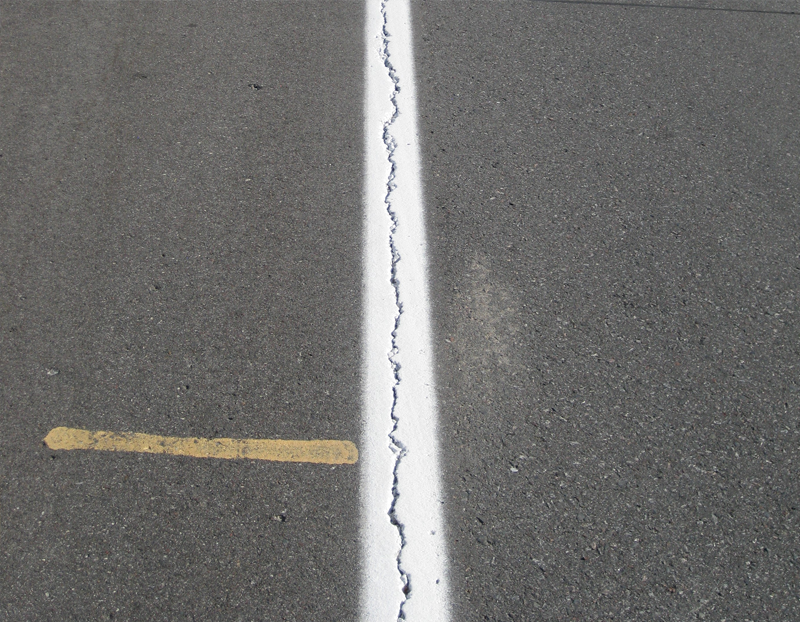
Low Severity
Continuous or intermittent cracks with an average crack width less than 1⁄4 inch.
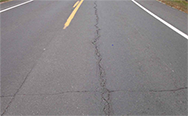
Medium Severity
Continuous or intermittent cracks with an average crack width between 1⁄4 inch and 1⁄2 inches with some spalling or loose pieces.
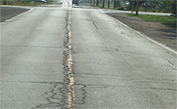
High Severity
Continuous cracks with an average crack width greater than 1 1⁄2 inches or severe spalling or loose pieces and or significant spalling, loose pieces, or missing material.
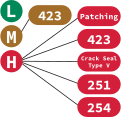
Notes:
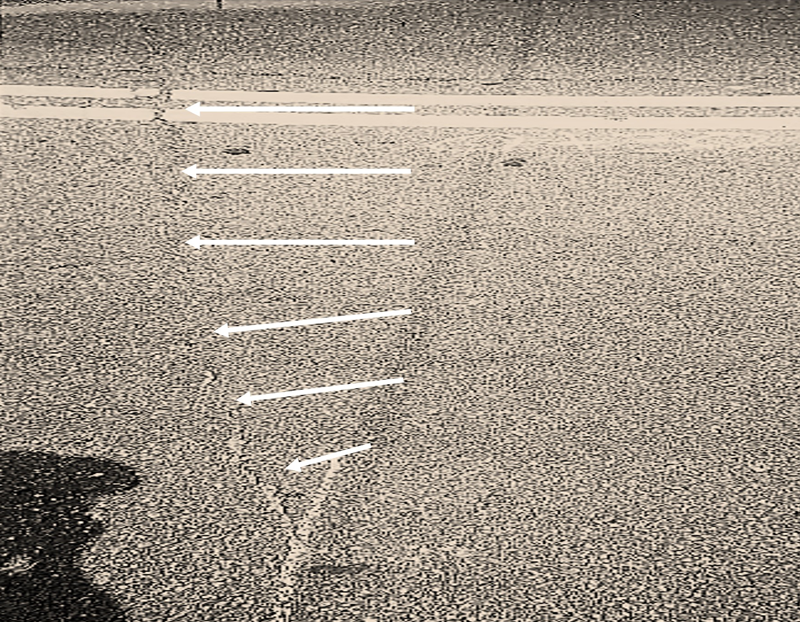
Description: A crack that intersects any transverse reflective crack (from an underlying joint or crack) and a longitudinal edge or centerline diagonally.
Most Likely Cause: Corner break in the underlying concrete base that reflects through to the asphalt surface. Loss of subgrade or base support, often due to water infiltration, subgrade erosion, or differential settlement cracks the underlying concrete. Corner breaks are sometimes longitudinal cracks in the underlying concrete that start at a transverse joint and turn towards the longitudinal joint rather than progress the full length of the slab.
Low Severity
Corner break area shows no visible depression.
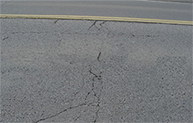
Medium Severity
Corner break area is depressed less than 2 inches and some visible spalling.
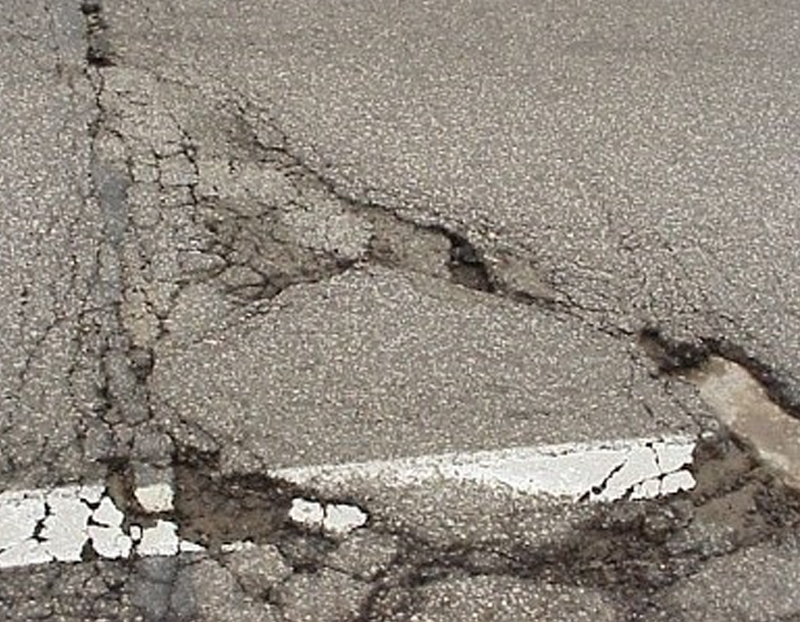
High Severity
Corner break area is depressed more than 2 inches or pumping and spalling exists.

Notes:
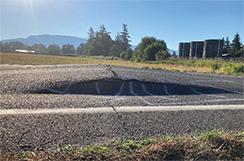
Description: Bump or hump in the pavement surface at a transverse joint or crack.
Most Likely Cause: Thermal expansion in the underlying concrete layer.
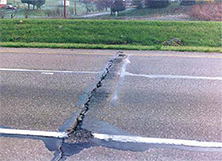
Low Severity
Bump height less than ½ inch, barely noticeable effect on ride.
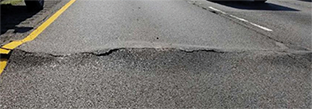
Medium Severity
Bump height ½ to 1 inch with a readily noticeable effect on ride.
High Severity
Bump height greater than 1 inch, severely reducing ride quality.
Low Severity: Do nothing.
Medium or High Severity: Full Depth Rigid Pavement Repair (Item 255).

Notes:
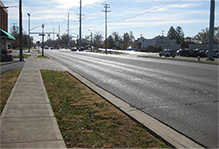
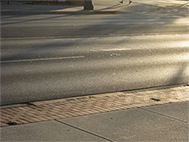
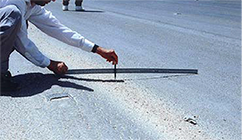
Description: Vertical depressions in the pavement surface along the wheel tracks.
Most Likely Cause: Permanent deformation or lateral movement of one or more of the asphalt layers under traffic. For composite pavements there is no rutting from the underlying layers because of the stiff concrete base underneath the asphalt layers.
Low Severity
Barely noticeable, depth less than 3⁄8 inch.
Medium Severity
Readily noticeable with a depth more than 3⁄8 inch and less than 3⁄4 inch.
High Severity
Readily noticeable with a depth greater than 3⁄4 inch.

Notes:
Description: Cracked rectangular or triangular area usually along the outside pavement edge.
Most Likely Cause: Concrete that is overstressed because of short transverse crack spacing and/or poor support of the underlying reinforced pavement. The punchout from the underlying reinforced concrete reflects through to the asphalt surface.
This distress is rated only for Medium and High levels.
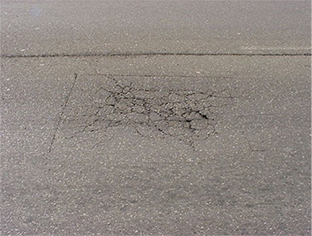
Medium Severity
Distressed area is depressed less than 2 inches.
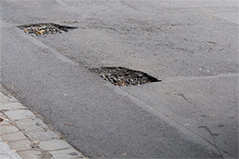
High Severity
Distressed area is depressed more than 2 inches.
Medium or High Severity: Full Depth Rigid Pavement Repair (Item 255).

Notes:
Description: Dip in the longitudinal profile of the pavement surface.
Most Likely Cause: Subgrade or base instability, deterioration or cracks in the underlying concrete base, inadequate compaction, weak soils, or poor drainage.
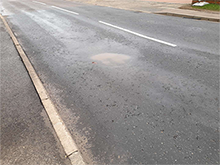
Low Severity
Drivers able to maintain ride easily.
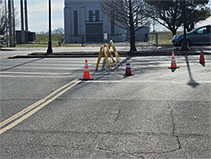
Medium Severity
Drivers able to maintain ride with slight corrective action.
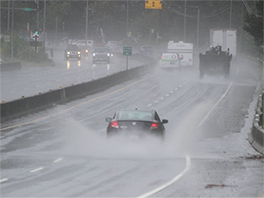
High Severity
Noticeable dip in pavement surface generally greater than 4 inches. High potential for poor ride quality.
Low Severity: Do nothing.
Medium and High Severity: Full Depth Rigid Pavement Repair (Item 255).

Notes:
Description: Ejection of water and fine soil particles through pavement cracks, joints, or along pavement edges.
Most Likely Cause: Water entering through joints or cracks, combined with repeated heavy vehicle loads, poor load transfer at the underlying concrete joints, and weak subgrade or base layers.
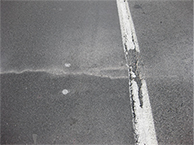
Low Severity
Small amount of surface staining from water and fines.
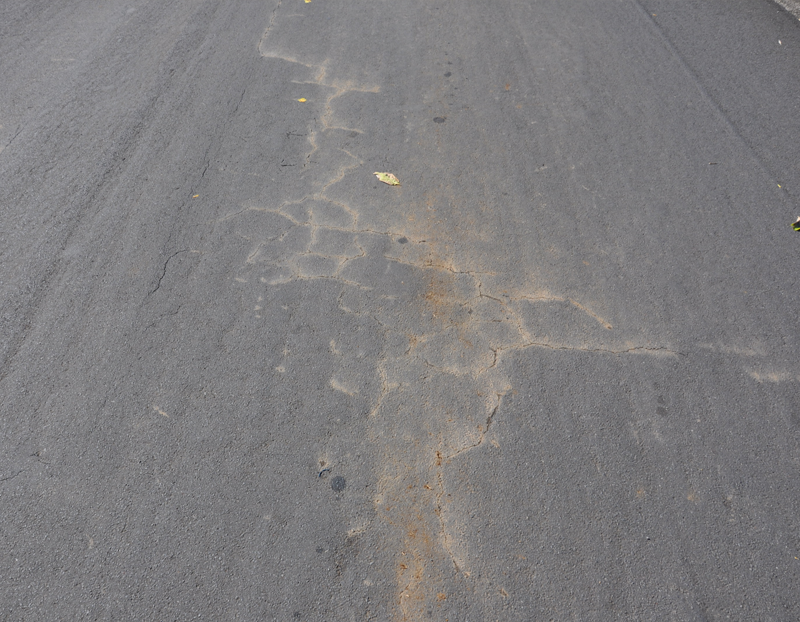
Medium Severity
Noticeable amount of surface staining from water and fines.
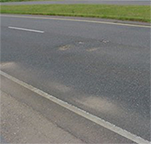
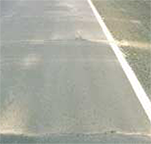
High Severity
Significant amount of surface staining from water and fines.
Low Severity: Do nothing.
Medium and High Severity: Full Depth Rigid Pavement Repair (Item 255).

Notes:
Description: A wave-like bulge or ripple in the asphalt surface, often appearing at locations where vehicles frequently slow down or stop.
Most Likely Cause: Weak or unstable asphalt mix along with forces from braking and turning of heavy vehicles.
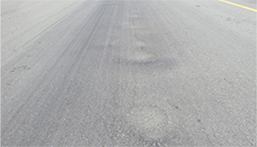
Low Severity
Barely noticeable. Maximum depth less than 3⁄8 inch.
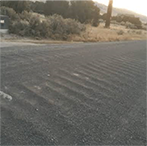
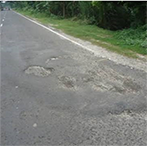
Medium Severity
Readily noticeable with a maximum depth more than 3⁄8 inch and less than 3⁄4 inch.
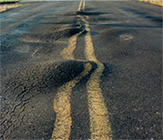
High Severity
Readily noticeable with a maximum depth greater than 3⁄4 inch.
Low Severity: Do nothing.
Medium or High Severity: Partial Depth Flexible Pavement Repair (Item 251).
Notes:
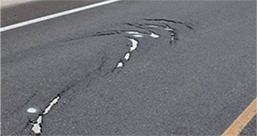
Description: Crescent-shaped crack where the top asphalt layer has slipped over the underlying layer.
Most Likely Cause: Poor bonding between asphalt layers due to missing or insufficient tack coat or a low-strength surface asphalt mix, along with forces from braking and turning of heavy vehicles.
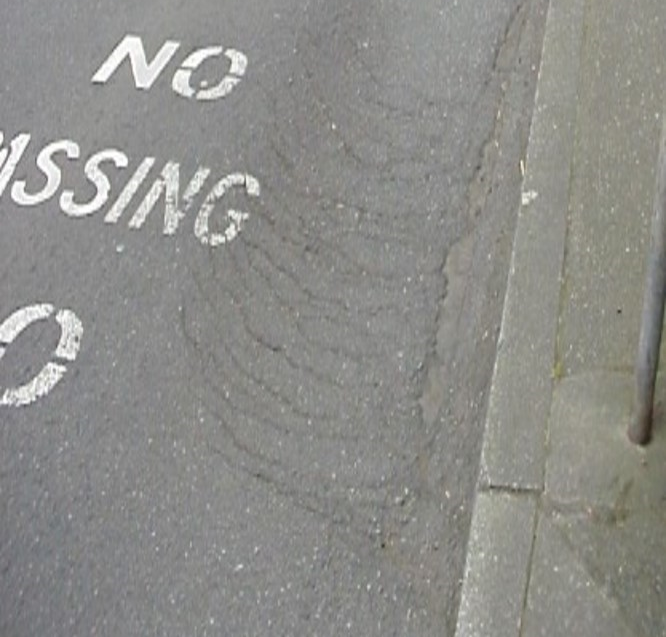
Low Severity
Closely spaced hairline cracks with no breakups.
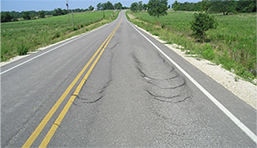
Medium Severity
Cracks clearly noticeable with minimal breakups.
High Severity
Cracks clearly noticeable with breakups and clear separation from the underlying layer.
Low Severity: Do nothing.
Medium or High Severity: Partial Depth Flexible Pavement Repair (Item 251).

Notes:
Description: Disintegration of pavement surface.
Most Likely Cause: Aggregate loss, asphalt binder aging, poor mixture quality, segregation, or insufficient compaction.
Design: Do nothing, Pavement Planing (Item 254) and overlay, surface treatment or Partial Depth Flexible Pavement Repair (Item 251) only if isolated.
Construction: Do nothing, Pavement Planing (Item 254) and overlay, surface treatment, or Partial Depth Flexible Pavement Repair (Item 251) only if isolated.
Maintenance: Do nothing or Partial Depth Flexible Pavement Repair (Item 251) only if isolated.
Description: Presence of free asphalt binder on the pavement surface.
Most Likely Cause: Excess amount of bituminous binder in the mixture and/or low air void content. More common on hot days, which reduces the viscosity of the asphalt binder.
Design: Do nothing, surface treatment, or Pavement Planing (Item 254) and overlay.
Construction: Do nothing, surface treatment, or Pavement Planing (Item 254) and overlay.
Maintenance: Sand bleed spots to soak up excess binder.
Description:Longitudinal cracks that are formed in the middle of the lane.
Most Likely Cause: Auger gearbox segregation during asphalt paving.
Design Do nothing, Pavement Planing (Item 254) and overlay, or Crack Sealing (Item 423).
Construction:Do nothing, Pavement Planing (Item 254) and overlay, or Crack Sealing (Item 423).
Maintenance: Do nothing or Crack Sealing (Item 423).